Do you ever feel anxious but can’t find the right words to explain it? That’s where similes can help.
In simple terms, similes compare one thing to another using “like” or “as,” making your feelings easier to picture and understand.
For example, instead of saying “I felt tense,” you might say, “The worry clung to me like a tight knot.” Similes make emotions clearer, more vivid, and more relatable.
In creative writing, they bring your inner world to life and help readers connect with your experience. Let’s explore powerful similes for anxiety, how they work, and how you can create your own.
120+ Powerful Similes for Anxiety
Here are some examples of similes for anxiety, each explained and demonstrated with sentences you can use as inspiration.
Anxiety is like a swarm of bees in my chest.
Meaning: Anxiety feels sudden, chaotic, and overwhelming.
Explanation: This simile conveys a physical, almost painful feeling of restlessness.
Example Sentences:
- My anxiety buzzed like a swarm of bees during the interview.
- Every time I thought about the exam, my chest stung like a swarm of bees.
Anxiety is like a heavy fog clouding my mind.
Meaning: Confusion and difficulty thinking clearly.
Explanation: Suggests mental blockage and disorientation.
Example Sentences:
- Decisions became impossible with my mind like a heavy fog.
- Anxiety settled over me like a dense fog, making everything seem unclear.
Anxiety is like a ticking time bomb.
Meaning: The feeling of impending panic.
Explanation: Highlights tension and fear of sudden outbursts.
Example Sentences:
- My stomach churned like a ticking time bomb before the speech.
- Every deadline felt like a ticking time bomb, ready to explode.
Anxiety is like a storm churning in my stomach.
Meaning: Uneasy, restless physical sensations.
Explanation: Compares inner turmoil to unpredictable weather.
Example Sentences:
- My anxiety swirled like a storm in my stomach.
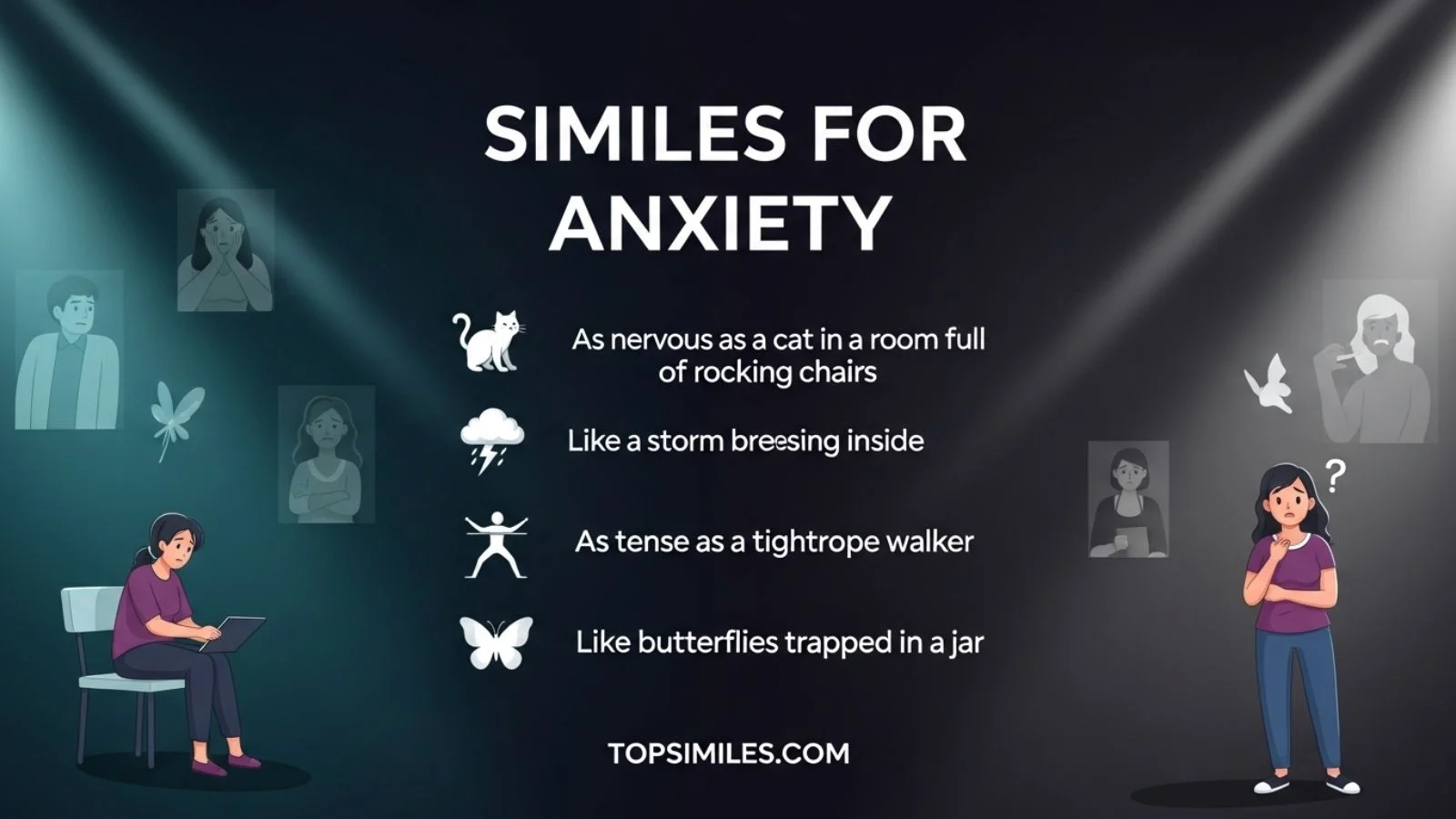
- Even minor stress felt like a storm brewing inside me.
Anxiety is like walking on a tightrope over a pit.
Meaning: Feeling unstable or exposed.
Explanation: Conveys fear of failure or missteps.
Example Sentences:
- Presenting in front of the class felt like walking on a tightrope.
- With every misstep, my confidence wavered like a tightrope walker.
Anxiety is like a knot tightening in my throat.
Meaning: Difficulty speaking or expressing oneself.
Explanation: Shows the physical grip of worry.
Example Sentences:
- I couldn’t answer; the words caught like a knot in my throat.
- Fear twisted like a tight knot every time I spoke.
Anxiety is like being chased by shadows.
Meaning: Feeling constantly uneasy or threatened.
Explanation: Suggests fear that follows you everywhere.
Example Sentences:
- My thoughts haunted me like shadows in the night.
- Anxiety crept around me like shadows, never letting go.
Anxiety is like ice in my veins.
Meaning: Feeling frozen or paralyzed.
Explanation: Expresses emotional numbness.
Example Sentences:
- I froze at the question, ice running through my veins.
- Anxiety gripped me, leaving me cold and still.
Anxiety is like fire under my skin.
Meaning: Restlessness or irritation.
Explanation: Highlights inner agitation.
Example Sentences:
- My fingers itched like fire under my skin.
- Every delay stoked the fire of anxiety.
Anxiety is like a shadow that won’t leave.
Meaning: Persistent, ongoing fear.
Explanation: Describes lingering stress.
Example Sentences:
- Even on sunny days, anxiety lingered like a shadow.
- My mind couldn’t shake the shadow of worry.
Anxiety is like a rattling cage inside me.
Meaning: Feeling trapped or restless.
Explanation: Suggests clashing thoughts.
Example Sentences:
- My thoughts clanged like a rattling cage.
- I paced, feeling like a caged animal.
Anxiety is like quicksand pulling me down.
Meaning: Feeling overwhelmed and stuck.
Explanation: Shows struggle and helplessness.
Example Sentences:
- Every obligation sank me like quicksand.
- Panic dragged me down like quicksand.
Anxiety is like a buzzing neon sign I can’t turn off.
Meaning: Constant alertness or distraction.
Explanation: Emphasizes intrusive thoughts.
Example Sentences:
- My mind flashed warnings like a neon sign.
- The worry glowed like a buzzing neon light.
Anxiety is like a tightrope in a windstorm.
Meaning: Feeling unstable in stressful moments.
Explanation: Conveys vulnerability.
Example Sentences:
- Facing criticism felt like balancing on a tightrope.
- Every choice trembled like a rope in the wind.
Anxiety is like chains around my wrists.
Meaning: Feeling restricted.
Explanation: Suggests helplessness.
Example Sentences:
- Procrastination weighed like chains.
- Fear held me captive like heavy chains.
Anxiety is like a storm cloud over my head.
Meaning: A gloomy, persistent emotional state.
Explanation: Evokes darkness or worry.
Example Sentences:
- My mood darkened like a storm cloud.
- Anxiety hovered like clouds ready to burst.
Anxiety is like jumping off a cliff in the dark.
Meaning: Fear of uncertainty.
Explanation: Suggests risk and unpredictability.
Example Sentences:
- Starting a new job felt like leaping in darkness.
- Anxiety made each decision feel like a cliff jump.
Anxiety is like a swarm of gnats buzzing in my mind.
Meaning: Persistent, irritating thoughts.
Explanation: Shows mental distraction.
Example Sentences:
- Thoughts pestered me like gnats.
- Anxiety flitted like tiny insects in my brain.
Anxiety is like walking through a dark tunnel with no end.
Meaning: Feeling lost or hopeless.
Explanation: Suggests long-term struggle.
Example Sentences:
- Panic felt like a tunnel with no exit.
- I moved carefully like a traveler in darkness.
Anxiety is like a drum beating inside my skull.
Meaning: Overwhelming mental pressure.
Explanation: Suggests pounding worry.
Example Sentences:
- My head pounded like a drum with anxiety.
- Every thought rattled like heavy drumbeats.
Practical Exercise: Test Your Simile Skills
Try these 10 interactive exercises to practice identifying and completing similes.
My stomach feels ________ like ________.
Anxiety grips me like ________.
My mind is spinning like ________.
Worry sticks to me like ________.
My heart races like ________.
Fear lingers in my mind like ________.
I feel trapped like ________.
My thoughts swarm like ________.
Anxiety weighs on me like ________.
I feel frozen like ________.
Answers with Explanations
a swarm of bees — shows restlessness
chains around my wrists — restriction
a spinning top — confusion
glue on my hands — clinging worry
a galloping horse — fast heartbeat
a storm cloud — lingering fear
a caged animal — trapped feeling
gnats — irritating, persistent thoughts
a heavy backpack — emotional weight
ice — fear-induced stillness
FAQs:
What is a simile for anxiety?
A comparison using “like” or “as” to describe anxious feelings.
How do similes help with writing about anxiety?
They make emotions clearer, vivid, and relatable.
Can I use similes in creative writing?
Yes, they add depth, imagery, and emotional impact.
What are examples of similes for anxiety?
Phrases like “like a storm inside” or “as restless as thunder.”
How do I create similes for my own feelings?
Compare your emotions to simple, relatable images.
Conclusion: Why Similes Make Anxiety Visible
Similes are more than just pretty language—they give shape to the invisible. Creative writing similes turn abstract feelings like anxiety into something tangible, relatable, and powerful.
By comparing your emotions to vivid images, you make your writing more engaging and help readers truly understand your experience.
Next time you feel anxious, try putting it into words with a simile. Start simple, play with ideas, and experiment.
Your anxiety can become a bridge to understanding—both for you and for anyone who reads your work. The more you practice, the easier it becomes to create your own simile sentences, and you may find that expressing your feelings this way brings a small sense of relief too.

Frank J. Wilstach is a passionate language enthusiast and grammar writer at topsimiles, where he makes English usage and wordplay accessible and engaging.
With a knack for clear explanations and memorable examples, Frank helps readers master language, style, and expression with confidence.