Have you ever felt totally baffled and wished you had the perfect words to describe it? That’s where similes can help!
A simile compares two things using “like” or “as,” making your writing clear and memorable. Saying someone is “as busy as a bee,” for example, instantly paints a picture. Similes make your thoughts vivid and easy to understand.
If you’re new to creative writing or simply want to improve your style, learning similes for confused can be a game-changer.
In this guide, you’ll discover powerful examples, real sentences, and simple exercises to use similes with confidence.
What Are Similes and Why Use Them?
Before we dive into examples, let’s clarify what similes really are. Think of a simile as a bridge between your idea and the reader’s imagination. By comparing something abstract (like confusion) to something familiar, your audience instantly “gets it.”
For example:
- “He looked as confused as a cat in a room full of rocking chairs.”
Not only is this amusing, but it also creates a mental image that shows exactly how puzzled someone is. Using similes in creative writing helps your sentences pop, makes emotions more vivid, and keeps readers hooked. You might say that similes are like the seasoning in a dish—they make everything taste better!
55+ Similes for Confused
Here are 20 examples of similes specifically for expressing confusion. Each one comes with meaning, explanation, and sample sentences so you can see them in action.
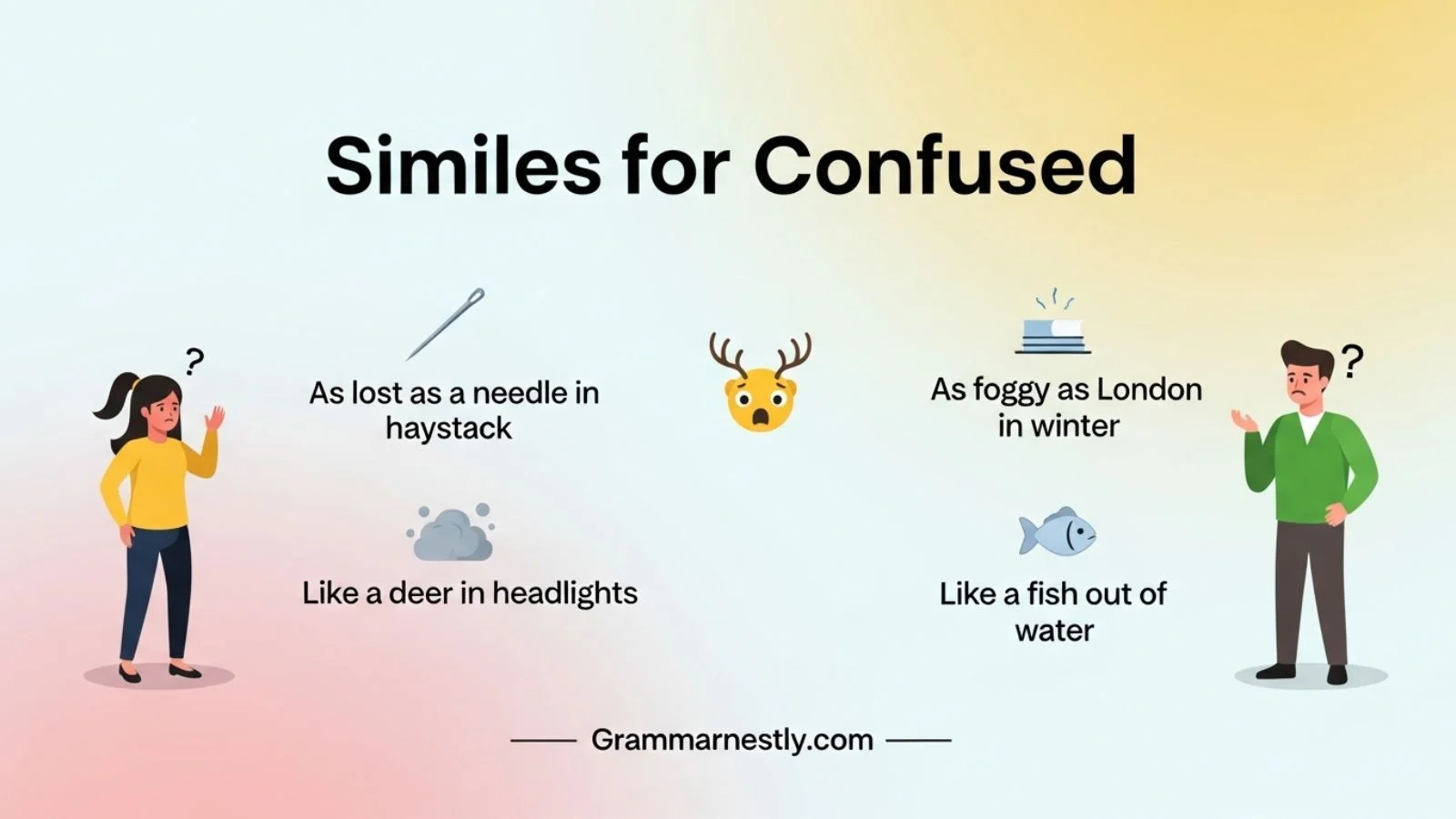
- As lost as a needle in a haystack
- Meaning: Completely unsure or unable to find one’s way.
- Explanation: Suggests being overwhelmed by too many options or distractions.
- Examples:
- She felt as lost as a needle in a haystack when she entered the new school.
- I was as lost as a needle in a haystack trying to understand his instructions.
- As puzzled as a fox in a henhouse
- Meaning: Bewildered and unsure of what to do next.
- Explanation: A fox in a henhouse faces unexpected complications, much like confusion.
- Examples:
- He was as puzzled as a fox in a henhouse after reading the riddle.
- She looked as puzzled as a fox in a henhouse when asked about her homework.
- Like a deer in headlights
- Meaning: Frozen with shock or confusion.
- Explanation: Describes someone stunned and unsure how to react.
- Examples:
- I was like a deer in headlights when the teacher called on me unexpectedly.
- He froze like a deer in headlights during the surprise exam.
- As confused as a chameleon in a bag of Skittles
- Meaning: Totally unsure about what’s happening.
- Explanation: A chameleon can’t decide which color to choose, just like someone confused.
- Examples:
- She was as confused as a chameleon in a bag of Skittles reading the instructions.
- I felt as confused as a chameleon in a bag of Skittles at the new office.
- Like a headless chicken
- Meaning: Acting in a frantic, confused manner.
- Explanation: Suggests chaos and lack of direction.
- Examples:
- He ran around like a headless chicken trying to fix the problem.
- She flapped about like a headless chicken when the deadline approached.
- As baffled as a tourist without a map
- Meaning: Totally unsure where to go or what to do.
- Explanation: A visual representation of uncertainty and disorientation.
- Examples:
- I felt as baffled as a tourist without a map in the subway.
- He was as baffled as a tourist without a map when faced with the new software.
- Like a fish out of water
- Meaning: Uncomfortable and confused in an unfamiliar situation.
- Explanation: Highlights a mismatch between environment and expectation.
- Examples:
- She felt like a fish out of water at the formal dinner.
- I was like a fish out of water in the coding workshop.
- As mixed up as socks in a dryer
- Meaning: Totally jumbled or confused.
- Explanation: Suggests disarray and disorder.
- Examples:
- My thoughts were as mixed up as socks in a dryer after that meeting.
- He looked as mixed up as socks in a dryer reading the complex instructions.
- Like a spinning top
- Meaning: Dizzy and confused by too much happening at once.
- Explanation: A top spins out of control, much like a confused mind.
- Examples:
- She was like a spinning top trying to manage both jobs.
- I felt like a spinning top after the sudden announcement.
- As foggy as London in winter
- Meaning: Unclear or confused in thought.
- Explanation: Evokes an image of clouded, unclear vision.
- Examples:
- My mind was as foggy as London in winter after the lecture.
- He felt as foggy as London in winter while solving the puzzle.
- Like a maze without an exit
- Meaning: Completely lost or perplexed.
- Explanation: Suggests complexity and no clear solution.
- Examples:
- She was like a maze without an exit trying to follow the recipe.
- I felt like a maze without an exit in that new city.
- As bewildered as a cat in a dog park
- Meaning: Confused and out of place.
- Explanation: Being in the wrong environment creates disorientation.
- Examples:
- He was as bewildered as a cat in a dog park during the debate.
- She looked as bewildered as a cat in a dog park at the costume party.
- Like a puzzle missing pieces
- Meaning: Confused because something important is missing.
- Explanation: Suggests incomplete understanding.
- Examples:
- My explanation felt like a puzzle missing pieces.
- She looked like a puzzle missing pieces after the briefing.
- As lost as a balloon in the wind
- Meaning: Drifting aimlessly, confused.
- Explanation: Emphasizes lack of control and direction.
- Examples:
- He was as lost as a balloon in the wind in the new city.
- I felt as lost as a balloon in the wind trying to start the project.
- Like trying to read hieroglyphics
- Meaning: Unable to understand.
- Explanation: Something seems completely foreign and confusing.
- Examples:
- The instructions were like trying to read hieroglyphics.
- She felt like trying to read hieroglyphics when faced with legal terms.
- As flustered as a puppy in a storm
- Meaning: Overwhelmed and confused.
- Explanation: Imagery of panic and helplessness.
- Examples:
- He was as flustered as a puppy in a storm during the presentation.
- She felt as flustered as a puppy in a storm juggling tasks.
- Like a clock with missing hands
- Meaning: Completely unsure about what’s happening.
- Explanation: Without guidance, you can’t know the time—just like confusion.
- Examples:
- I felt like a clock with missing hands in the new course.
- He was like a clock with missing hands trying to understand the plan.
- As perplexed as a detective with no clues
- Meaning: Confused due to lack of information.
- Explanation: Evokes the struggle to solve a mystery without guidance.
- Examples:
- She was as perplexed as a detective with no clues reading the contract.
- I felt as perplexed as a detective with no clues in that argument.
- Like a kite in a thunderstorm
- Meaning: Confused and out of control.
- Explanation: Suggests chaos and unpredictability.
- Examples:
- He felt like a kite in a thunderstorm facing sudden changes.
- She was like a kite in a thunderstorm when deadlines shifted.
- As tangled as headphones in a pocket
- Meaning: Mentally confused or disorganized.
- Explanation: Simple, relatable image of confusion.
- Examples:
- My thoughts were as tangled as headphones in a pocket.
- He looked as tangled as headphones in a pocket after the lecture.
Practical Exercise: Identify or Complete the Simile
| Exercise Sentence | Options (if any) | Correct Answer | Explanation |
|---|---|---|---|
| She felt _________, staring at the complex chart. | a) like a fish out of water b) as happy as a clam | like a fish out of water | Unfamiliar and confused. |
| He was _________ when he couldn’t find the keys. | a) as lost as a needle in a haystack b) like a bird in flight | as lost as a needle in a haystack | Completely unsure. |
| I was _________ when the new app kept crashing. | — | like a spinning top | Dizzy and confused. |
| She looked _________ at the strange menu. | a) as puzzled as a fox in a henhouse b) like a lion on the hunt | as puzzled as a fox in a henhouse | Unsure what to do. |
| My mind was _________ after the lecture. | — | as foggy as London in winter | Unclear and confused. |
| He felt _________ at the crowded event. | a) like a deer in headlights b) as comfortable as home | like a deer in headlights | Frozen and bewildered. |
| I was _________ trying to fix the broken bike. | — | like a headless chicken | Frantic and confused. |
| She was _________ by the sudden news. | a) as flustered as a puppy in a storm b) like a calm lake | as flustered as a puppy in a storm | Overwhelmed. |
| My thoughts were _________ after reading the complicated instructions. | — | as tangled as headphones in a pocket | Disorganized and confused. |
| He looked _________ in the new city. | a) like a kite in a thunderstorm b) as confident as a leader | like a kite in a thunderstorm | Out of control and puzzled. |
FAQs
1. What is a simile in simple words?
A simile is a comparison using “like” or “as” to make writing clearer and more vivid.
2. Why use similes to express confusion?
Similes help readers instantly picture emotions like confusion, making your writing stronger, relatable, and more engaging.
3. How do similes improve creative writing?
They add imagery, emotion, and depth, helping your sentences feel more alive and memorable.
4. Can beginners use similes easily?
Yes! Similes are simple to learn and work well in everyday writing, stories, essays, and descriptions.
5. How can I create my own similes for confused?
Think of something that feels lost, unclear, or chaotic, then compare your feeling using “like” or “as.”
Conclusion
Similes are powerful tools in creative writing, helping you express emotions like confusion in a vivid, relatable way.
Whether you use them to describe a character, a situation, or even your own feelings, similes make your writing memorable.
By exploring these 55+ similes for confused, practicing exercises, and trying your own comparisons, you’ll start to see how fun and expressive writing can be.
So next time you feel puzzled or bewildered, think of a simile—it might just make your sentence shine!

Hey there! I’m Amy Leach, a playful explorer of language and words. I love twisting phrases, creating magical images, and making the ordinary feel extraordinary.
On topsimiles, I share my favorite similes, idioms, and metaphors to help you bring words to life. Join me as we have a blast discovering the wonders of language!