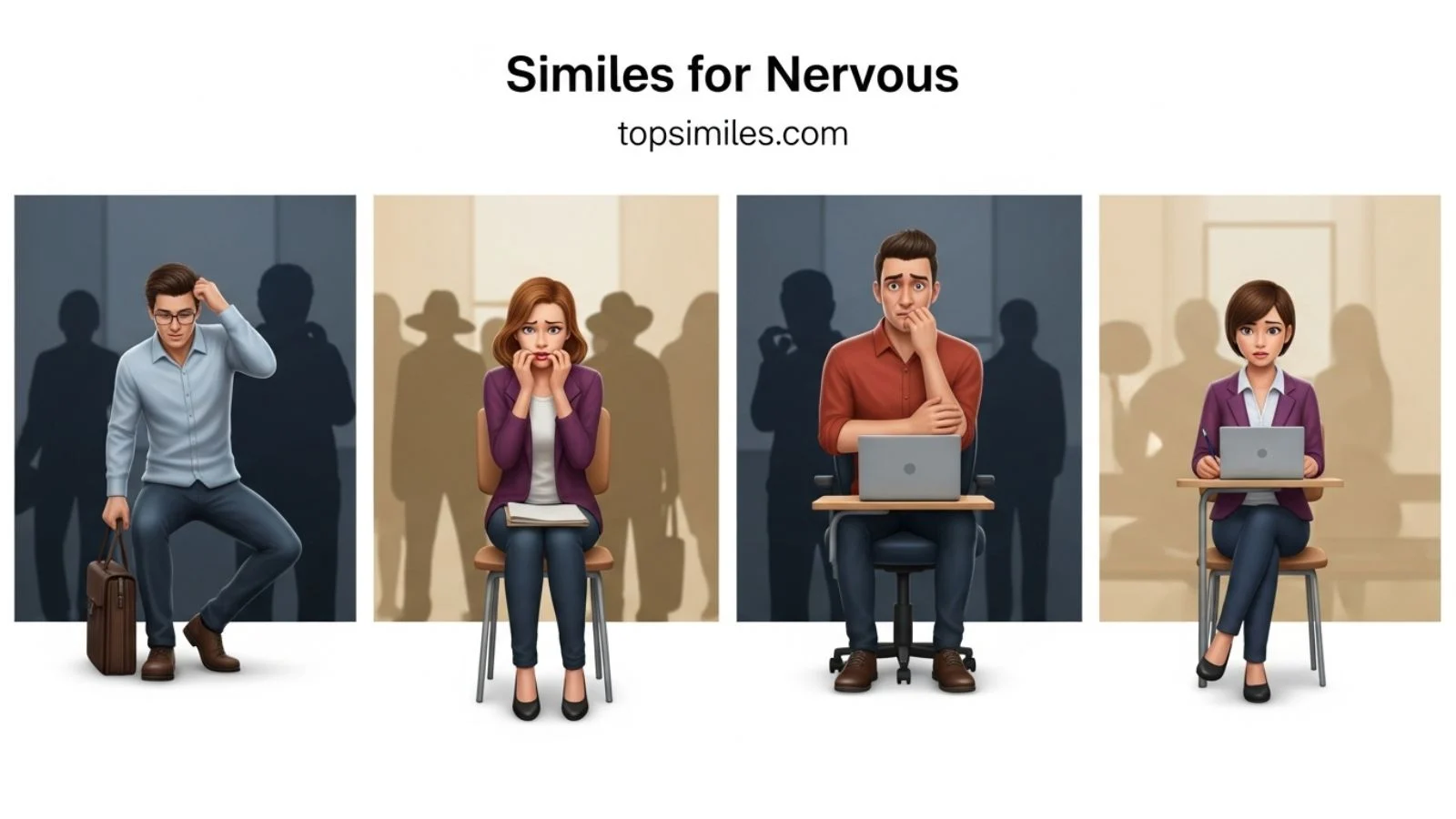
Feeling nervous happens to everyone—before a presentation, exam, or big decision. But it’s hard to describe that anxious, jittery feeling. That’s where similes for nervous help.
A simile uses “like” or “as” to turn emotions into vivid images. For example: “He felt as jittery as a squirrel in a thunderstorm” immediately shows tension and restlessness.
If you’re looking for examples of similes for nervous or creative writing similes, this guide has 20 expressive similes, meanings, examples, and a short exercise to practice.
Let’s explore similes that capture nervousness perfectly!
150 Similes for Nervous
“He felt as jittery as a squirrel in a thunderstorm.”
Meaning: Extremely anxious or tense.
Explanation: Squirrels are hyperactive and alert; a storm intensifies this.
Examples:
- Before his speech, he felt as jittery as a squirrel in a thunderstorm.
- Waiting for the exam results, she was jittery like a storm-fearful squirrel.
“Her hands shook like leaves in the wind.”
Meaning: Physical signs of nervousness.
Explanation: Leaves tremble when blown by wind, just like nervous hands.
Examples:
- Her hands shook like leaves when she answered the phone.
- He gripped the pen, hands shaking like leaves in the breeze.
“He was like a cat on a hot tin roof.”
Meaning: Restless and uneasy.
Explanation: Cats on hot surfaces move constantly; nervousness causes similar fidgeting.
Examples:
- He paced the room like a cat on a hot tin roof.
- She tapped her foot, restless like a cat on a hot tin roof.
“Her stomach fluttered like butterflies in a jar.”
Meaning: Nervous anticipation.
Explanation: Butterflies in a confined space reflect anxious energy.
Examples:
- Before the interview, her stomach fluttered like butterflies in a jar.
- He felt nervous, like butterflies trapped inside.
“He felt like a mouse caught in a trap.”
Meaning: Fearful, trapped, and anxious.
Explanation: A trapped mouse symbolizes helpless nervousness.
Examples:
- Facing the principal, he felt like a mouse in a trap.
- She froze like a mouse caught in a trap.
“Her heart raced like a runaway train.”
Meaning: Physical panic or excitement.
Explanation: A train speeding uncontrollably mirrors rapid heartbeat under stress.
Examples:
- Her heart raced like a runaway train before the test.
- He felt panic, heart racing like a train off its tracks.
“He was as tense as a tightly coiled spring.”
Meaning: Ready to snap, high-strung.
Explanation: A spring stores energy and tension, just like a nervous person.
Examples:
- He waited, as tense as a coiled spring.
- She felt wound up, like a spring ready to pop.
“Her thoughts tumbled like marbles on a staircase.”
Meaning: Chaotic, racing thoughts.
Explanation: Nervous minds often have scattered, uncontrollable ideas.
Examples:
- While waiting for the call, her thoughts tumbled like marbles.
- He couldn’t focus; thoughts ran wild like marbles down stairs.
“He moved like a fox in a trap.”
Meaning: Nervous, alert, and cautious.
Explanation: A trapped fox is cautious and anxious, reflecting nervous behavior.
Examples:
- Walking into the office, he moved like a fox in a trap.
- She glanced around, moving cautiously like a trapped fox.
“Her voice quivered like a fragile icicle.”
Meaning: Trembling due to nervousness.
Explanation: Icicles are delicate and prone to shaking, like a nervous voice.
Examples:
- She spoke softly, voice quivering like an icicle.
- His first words to the crowd came out quivering like fragile ice.
“He felt like a rabbit in headlights.”
Meaning: Frozen in fear or anxiety.
Explanation: Rabbits freeze when caught in danger, similar to nervousness.
Examples:
- During the surprise question, he felt like a rabbit in headlights.
- She froze, like a rabbit stunned by bright lights.
“Her palms were as clammy as wet clay.”
Meaning: Physical sign of anxiety.
Explanation: Nervous sweating makes palms moist; wet clay conveys this tactile image.
Examples:
- She gripped the mic, palms as clammy as wet clay.
- He wiped hands sweaty and clammy like wet clay.
“He twitched like a puppet with loose strings.”
Meaning: Involuntary nervous movements.
Explanation: Uncontrolled twitching reflects anxious energy.
Examples:
- He twitched nervously like a puppet with loose strings.
- She couldn’t sit still, moving like a puppet.
“Her stomach churned like stormy seas.”
Meaning: Uneasy, anxious feeling in the gut.
Explanation: Turbulent seas mirror the turmoil in nervousness.
Examples:
- Waiting for results, her stomach churned like stormy seas.
- He felt uneasy, stomach churning like rough waves.
“He was as uneasy as a dog in a thunderstorm.”
Meaning: Anxious and distressed.
Explanation: Dogs sense danger and worry during storms, like nervous humans.
Examples:
- He paced like a dog in a thunderstorm.
- She felt anxious, like a dog hearing thunder.
“Her knees wobbled like jelly.”
Meaning: Physical reaction to nervousness.
Explanation: Weak knees reflect fear, tension, or excitement.
Examples:
- Before stepping on stage, her knees wobbled like jelly.
- He tried to stand tall, but knees wobbled like jelly.
“He felt like a leaf caught in a whirlwind.”
Meaning: Out of control and anxious.
Explanation: A leaf tossed by wind mirrors a feeling of helpless nervousness.
Examples:
- Thoughts spinning, he felt like a leaf in a whirlwind.
- She was swept up by anxiety, like a leaf tossed by wind.
“Her chest tightened like a vice.”
Meaning: Anxiety-induced physical tension.
Explanation: Tightness in the chest mimics the grip of a vice.
Examples:
- She struggled to breathe, chest tight like a vice.
- He felt nervous, chest constricted like a vice.
“He bounced like a ping pong ball on a table.”
Meaning: Restless energy, inability to stay still.
Explanation: Nervous energy causes constant movement, like a ping pong ball.
Examples:
- He paced nervously, bouncing like a ping pong ball.
- She fidgeted in her seat, moving like a bouncing ball.
Practical Exercise: Identify or Complete the Simile
| Simile Start | Answer | Explanation |
|---|---|---|
| He felt as jittery as a ______ in a thunderstorm. | Squirrel | Anxious and tense energy. |
| Her hands shook like ______ in the wind. | Leaves | Physical signs of nervousness. |
| He was like a ______ on a hot tin roof. | Cat | Restless and uneasy. |
| Her stomach fluttered like ______ in a jar. | Butterflies | Nervous anticipation. |
| He felt like a ______ caught in a trap. | Mouse | Helpless and anxious. |
| Her heart raced like a ______ train. | Runaway | Rapid heartbeat under stress. |
| He was as tense as a tightly coiled ______. | Spring | High-strung nervousness. |
| Her thoughts tumbled like ______ on a staircase. | Marbles | Chaotic, racing thoughts. |
| He moved like a ______ in a trap. | Fox | Nervous and alert. |
| Her voice quivered like a fragile ______. | Icicle | Trembling due to nervousness. |
FAQs About Similes for Nervous
What is a simile?
A simile is a comparison using like or as.
Why use similes for nervousness?
They make anxious or jittery feelings relatable and vivid.
Can similes help in storytelling?
Yes, they show emotions clearly and make characters realistic.
How do I write my own similes for nervousness?
Compare your anxious feelings to visible, tangible objects or movements.
Are similes the same as metaphors?
No, similes use like or as, metaphors do not.
Conclusion
Similes help writers translate nervous energy, anxiety, and tension into vivid images readers can instantly understand. Using similes for nervous, you can make stories, poems, or personal reflections more expressive and relatable.
Now that you’ve explored examples, meanings, and exercises, try crafting your own. Think of moments when your heart raced, your hands shook, or your thoughts spiraled, and compare those feelings to something concrete—a squirrel, a leaf, or a spring. With practice, similes will become a powerful tool to make your writing emotionally engaging.